Wednesday, March 17, 2010


Bernard ran into an old friend this week.
Thursday, March 11, 2010

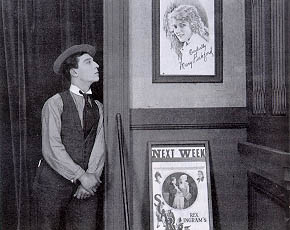
Max Davison in "The Call of the Cuckoo" (1927)


This comedy shows a bit more of the range of the period - especially since it's built on a kind of stereotyped portrayal of Jewish characters.

Harry Langdon - The Strong Man

Harry Langdon - Long Pants


Another great comic of the period, Harry Langdon - here in a very dark comedy.

Chaplin - The Great Dictator (1940) - The Final Scene


As the Jewish barber Schulz who impersonates the anti-semitic dictator Hynkel, Chaplin gives his own political speech to a world on the brink of World War II.

Chaplin - The Great Dictator (1940) - Hynkel's speech


With The Great Dictator, Chaplin used sound to add to his satirical portrayal of Adolf Hitler as the petty tyrant Adenoid Hynkel. Very broad comedy, hilarious stuff - and it got him to trouble years later when members of the House UnAmerican Activities Committee determined that he had been "prematurely hostile" to fascism and the Nazis.

Chaplin - Modern Times (1936) - The Waiter's Song


Ana amazing event for the contemporary audience - Charlie sings.

Chaplin - Modern Times (1936) - The Factory


The classic scene from Modern Times- The Tramp is now a worker, driven mad by the machine rhythms of factory work.

Chaplin - The Gold Rush (1925) - Dinner in the Cabin


Another classic comic scene.

Chaplin - The Gold Rush (1925) - Table Ballet


One of Chaplin's most famous set pieces.

Chaplin - The Idle Class (1921)


In "The Idle Class," Chaplin tells a sentimental, 19th-century sort of story abut crossing lines of class.

Chaplin - The Immigrant (1917)


"The Immigrant" shows Chaplin's consistent identification with the diverse immigrant population of the United States - his sense that "the people" really meant the people rejected and exploited by those with power.

Chaplin- One A. M. (1916)

Chaplin - The Police (1916)


Many of Chaplin's early comedies are available online, in versions of varying quality.
"Police" shows that Chaplin introduced social and political themes from early in his career.

Friday, March 5, 2010

This Just In


 F. W. Murnau's 1922 masterpiece of expressionist horror, Nosferatu: A Symphony of Terror, will be shown Thursday, March 11 at 6:30 pm at the Smithsonian Museum of American Art, with live original musical accompaniment by the Thad Wilson Group. Looks like it's free. Info here:

Nosferatu at American Art Museum

We'll see a bit of Nosferatu in just a few weeks, in our sessions on German silent film.

Wednesday, February 24, 2010

The Son of The Sheik (1926) - Rudolph Valentino

This excerpt illustrates what captivated filmgoers saw in Valentino - and why reformers thought he was too hot for the screen.

The Sheik with Rudolph Valentino - 1921 Part 3 of 9

The film that made Valentino an international sensation - and film history's prime instance of the movie star as sex symbol. The displacement of sexuality on to exotic cultures was already firmly established in films when "The Sheik" appeared - but Valentino's performances embodied the idea as no one else's ever did.

Tumbleweeds - W. S. Hart 1925


Hart's films set the terms and conventions for much of the history of the Western - one of the most influential and enduring of Hollywood genres.